Neuroplasticity: The Brain's Ability to Change
“The only thing permanent in nature is change.” -Dr. Ishan Shivanand
Years ago, I spent a few weeks in London, where I made a local friend who was kind enough to show me around. She would usually drive, and for the first week, almost every time we approached her car, my American-conditioned brain instinctively sent me to the wrong side.
When I returned home (after a long day of travel and flight delays), my father picked me up from the airport. Exhausted and looking forward to finally resting, we put my bags in the trunk, and I instinctively walked toward what had now become the “passenger side” in my mind. Except I was back in the U.S., and I had walked straight to the driver’s seat. And my father assumed I was offering to drive us home in rush hour traffic. So I did.
The brain becomes shaped, in part, by what it repeatedly experiences. And at the same time, the brain continues to change throughout life. Your brain is changing as you read this.
Neuroplasticity is the nervous system's ability to change its structure, function, and connections in response to experience.[1] It allows us to learn, remember, adapt, develop new skills, and recover some abilities following injury.[2] This is often referred to as “rewiring” your brain or nervous system. Neuroplasticity or rewiring isn't inherently positive or negative. It is simply the brain's capacity to adapt. That adaptation can help us learn a new language or instrument, but it can also reinforce patterns associated with chronic stress, fear, addiction, and chronic pain.[1,2]
First, Let's Learn About the Brain
The human brain contains roughly 86 billion specialized cells called neurons. Think of them as your brain's internal communication team, passing messages through vast networks. A single neuron can form connections with thousands of others. They talk to each other across tiny gaps called synapses using chemical and electrical signals.
But these connections aren't fixed in stone…
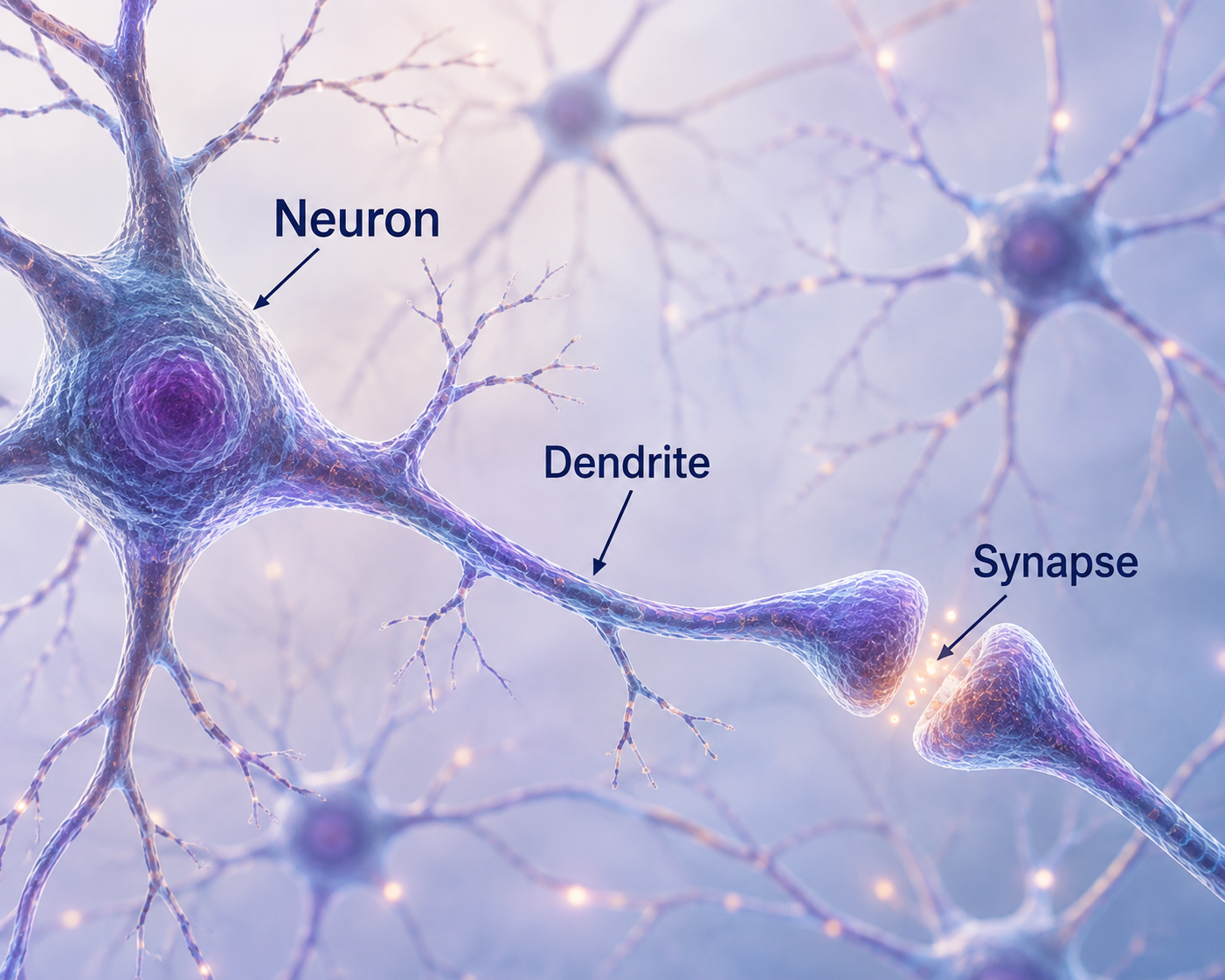
· Their strength can change.[1,2]
· New connections can form when you learn.[1,2]
· Existing connections can weaken when you stop using them.[1,2]
· The branching structures of your cells (called dendrites) can grow or shrink based on your daily life.[1,2]
The Levels of Brain Change
These changes in your brain happen on two different levels:
1. The Microscopic Level (Synaptic Plasticity): This is where individual neurons adjust their communication. The tiny connections between them can become physically stronger or weaker depending on how often they are used.[1,2]
2. The Large Scale Level (Regional & Network Changes): On a bigger scale, entirely different regions of the brain can change how they talk to one another. Entire neural networks can completely reorganize themselves in response to learning, repeated experiences, or even healing from an injury.[1,2]
What "Rewiring" Means for Your Mental Health
When you struggle with chronic stress, anxiety, worrying, or negative self-talk, it can feel like your mind is stuck on a loop. That is because those mental habits have built massive, high-speed highways in your brain. They feel automatic simply because you have accidentally given them a massive workout over the years. Think of your brain (and your entire nervous system) like a muscle. Those stressed-out connections are currently the strongest and heaviest because they get the most exercise.
But you have the power to build new exits and construction zones on those mental highways. By practicing self-awareness, positive habits, and self-care, you start exercising entirely different parts of your brain. Every time you pause a negative thought, you are redirecting traffic to a new path. Over time, those old anxious pathways will naturally weaken from a lack of use, and your new, peaceful pathways will become your brain's strongest, automatic default settings.
Can Neuroplasticity Become Less Efficient?
Yes, and this is where the idea of mental “stagnation” really belongs.
Our capacity for neuroplasticity changes across our lifespan. It tends to be greatest during early childhood development when our minds are like sponges.[1] As we grow older, the process naturally becomes less efficient, but it never completely disappears.[2] Your brain's potential to adapt isn't isolated. It is deeply connected to your body and environment. A variety of biological factors, environmental conditions, stress, perspectives, beliefs, and epigenetic influences (how your life experiences affect your genes) can all shift your brain's plastic potential.[1,2]
Because of this, certain things can create a much less favorable environment for your brain to adapt. Roadblocks include:
· Chronic stress and physical inactivity[1,2]
· Inadequate sleep and a lack of novel stimulation[1,2]
· Certain illnesses[1,2]
· Ongoing neuroinflammatory processes (chronic inflammation in the central nervous system, which can disrupt how the brain builds connections)[1]
· Behavioral and emotional rigidity, remaining within familiar patterns with fewer opportunities for new experiences and responses
· Being stuck in fight or flight of freeze. You nervous system focuses on protection.
A philosophical point to consider here: If we want our brains to remain adaptable, we have to keep giving them a reason to adapt. Your brain will not build a new pathway unless your life choices actively demand it.
Supporting Healthy Neuroplasticity
You can jumpstart this rewiring process every day with a few simple habits:
· Embrace New Experiences: Take a new route home, try a new hobby, pick up an instrument, learn a new language, or read a book on a new topic. Novelty wakes your brain up and forces it to build fresh connections.
· Repeat Healthy Habits: Consistency is key. Your brain will not strengthen a new pathway from a one-time effort. Practice positive self-talk or mindfulness daily until it feels natural.
· Meditation, journaling, therapy, introspection: By repeatedly training attention, awareness, and emotional regulation, with studies showing changes in brain structure and connectivity in regions involved in these functions.[4] In a sense, each time we notice an automatic response and redirect our attention, we practice another pathway.
· Emotional Openness: Our brains build new neural pathways, especially when we emotionally connect with the traits we hope to cultivate. When we choose to notice, choose, and regulate our emotions instead of slipping into a default mode, we change our wiring.[5]
· Prioritize Your Sleep: Your brain does its heavy restructuring work while you rest. Sleep is when your brain cements new memories and clears out old, unused connections.[1]
· Keep Moving: Physical exercise boosts a special brain protein called BDNF. Think of BDNF like "fertilizer" for your brain cells. It helps new connections grow much faster.
Try this now:
Turn both of your wrists clockwise 5 times, then counterclockwise 5 times.
Now try turning your left wrist clockwise while turning your right wrist counterclockwise at the same time.
Now, try doing that exact same progression with your ankles.
Next, roll your wrists and your ankles at the same time, in the same direction.
Let's make it tougher: try rolling your ankles one way, and your wrists the opposite way.
Ultimate test: roll your left wrist and left ankle one way, while rolling your right wrist and right ankle the other way.
Did your brain freeze up? That frustrating "buffering" feeling is the exact sensation of your brain desperately trying to build a new neural pathway in real-time.
To keep challenging your mind later today, try brushing your teeth with your opposite hand.
And Then There Are Psychedelics
Scientists (and hippies) have discovered a powerful accelerator for brain change: psychedelics. Researchers often call these substances psychoplastogens, which is just a scientific word for compounds that can rapidly reshape the brain's physical structure.[3]
· What They Are: These are compounds (like ketamine, psilocybin, or LSD) that trigger rapid, structural changes in the brain. Instead of just shifting brain chemistry temporarily like traditional medications, they physically alter the shape of the cells themselves.[3]
· How They Work on Cells: When these compounds enter the brain, they soak straight through the cell walls rather than just sitting on the surface. From the inside out, they signal the neuron to quickly sprout entirely new branches (dendrites) and build new connection points (synapses) within just a few hours.[3]
· What They Affect in the Brain: They temporarily turn down the volume on the brain's "Default Mode Network." This is the interconnected highway system in the brain responsible for your rigid, automatic thought loops, habits, and your sense of self.[3]
· The Result for Mental Health: By calming down that default network, psychedelics reopen a temporary window of high adaptability, similar to how a child’s brain learns. This window allows old, stuck patterns of thinking (like those found in trauma, depression, or addiction) to loosen up, making it much easier to practice and wire in healthier emotional responses.[3]
· Disclaimer: Psychedelics are not magic pills that erase problems on their own, and they are not safe for everyone. They do not automatically grant positive rewiring; instead, they simply open a temporary door of flexibility that requires proper guidance and/or integration for therapeutic benefit. Without a controlled environment or proper screening, they can severely worsen conditions like psychosis, schizophrenia, or severe bipolar disorder by triggering intense anxiety, paranoia, or distress.
Written by: Vivek Patel, MSN, FNP-C, PMHNP-BC
Last updated: August 2026
Medical Disclaimer: This article is for educational purposes only and is not a substitute for individualized medical advice.
References
1.Margetis K, Vadakekut ES. Neuroplasticity. [Updated 2026 May 24]. In: StatPearls [Internet]. Treasure Island (FL): StatPearls Publishing; 2026 Jan-. NCBI Bookshelf
2. Gazerani P. The neuroplastic brain: current breakthroughs and emerging frontiers. Brain Res. 2025;1858:149643. doi:10.1016/j.brainres.2025.149643. ScienceDirect
3. Grieco SF, Castrén E, Knudsen GM, Kwan AC, Olson DE, Zuo Y, Holmes TC, Xu X. Psychedelics and Neural Plasticity: Therapeutic Implications. J Neurosci. 2022;42(45):8439-8449. doi:10.1523/JNEUROSCI.1121-22.2022. PMID: 36351821; PMCID: PMC9665925. PubMed Central
4. Calderone A, Latella D, Impellizzeri F, et al. Neurobiological Changes Induced by Mindfulness and Meditation: A Systematic Review. Biomedicines. 2024;12(11):2613. PubMed Central
5. Giuliani NR, Drabant EM, Bhatnagar R, Gross JJ. Emotion regulation and brain plasticity: expressive suppression use predicts anterior insula volume. Neuroimage. 2011;58(1):10-15. doi:10.1016/j.neuroimage.2011.06.028. PMID: 21704173; PMCID: PMC3161031. PubMed Central
