The Trap of: “I’ll Be Happy When…”
“For one who has conquered the mind, the mind is the best of friends; but for one who has failed to do so, his mind will remain the greatest enemy.” - Bhagavad Gita 6.6
The mind has an extraordinary ability to shape how we experience life. Two people can encounter the same situation and walk away with entirely different experiences of it. The mind can turn uncertainty into possibility or fear, a setback into failure or redirection, and solitude into loneliness or peace. It can replay something that happened years ago and make it feel emotionally present, or imagine something that has not happened yet and create anxiety around a future that exists only in thought. It can also convince us that the next relationship, accomplishment, paycheck, or change will finally make us happy. Our circumstances matter, but so does the mind through which we experience them.
The Bhagavad Gita, a Vedic spiritual text, narrates a conflict that leads to an inevitable (dharmic) war between two branches of the same family. At the center of it all is Arjun, a skilled warrior and archer who rides into battle in his chariot, overwhelmed by the reality of fighting people he knows and loves. His charioteer is Krishna, understood as an incarnation of the Divine, who serves as Arjun’s guide and teacher. Through their conversation, they explore duty, action, attachment, the Self, and the nature of the mind.
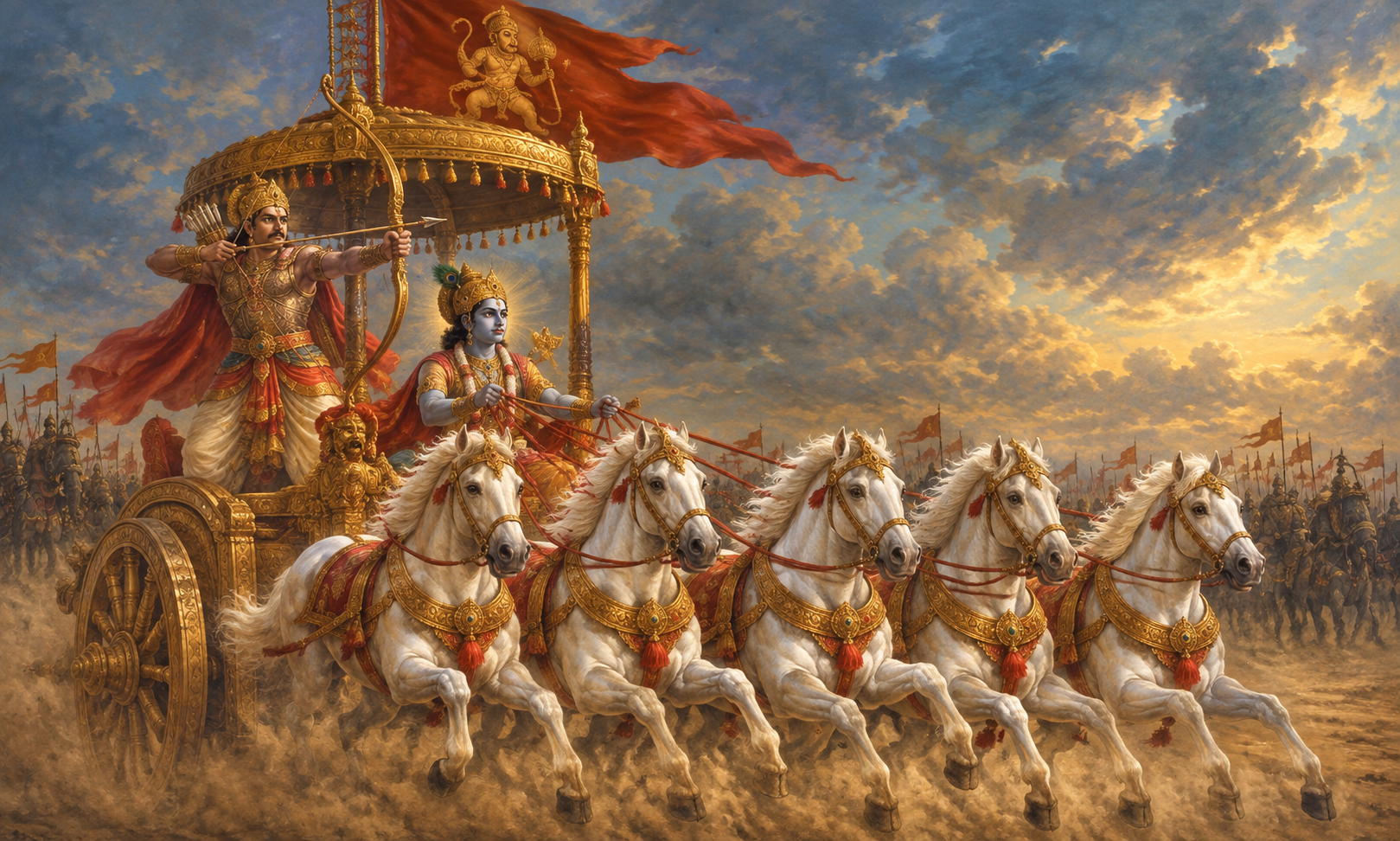
Without getting into the details of the war, I’d like to focus on one powerful image from the story that provides a useful visual analogy for understanding ourselves:
Arjun riding through battle in his chariot, pulled by five horses, with Krishna holding the reins. The chariot represents the physical body, the vehicle through which we move through life. Arjun, the passenger, represents the Self: the awareness experiencing the journey and performing action. The five horses represent our five senses, through which we experience and interact with the world around us. The reins represent the mind, connecting those senses to the Krishna, the charioteer. Krishna, holding the reins, represents higher wisdom and discernment: the capacity to guide the mind and determine the direction in which the chariot travels.
Each part must play its role for the chariot to function, navigate, and ultimately move in the intended direction. The horses allow us to experience the journey, just as our senses allow us to experience life, but they are not meant to determine the destination. The reins need to provide enough direction to guide the horses, but not be so restrictive that they prevent them from experiencing the path. The charioteer must remain aware and discerning enough to guide them, while the chariot itself must be well enough to carry everyone through the journey. Each part has its own purpose, but none operates entirely on its own.
Now imagine those five horses suddenly pulling toward whatever catches their attention. If the reins are loose, the horses begin determining the direction of the chariot. If the reins are pulled too tightly, they restrict the horses rather than guide them. If the charioteer loses awareness of the road ahead, the mind and senses have little meaningful direction. A disruption in one part changes how the entire system functions, potentially causing damage to the mind and body.
The same can happen within us. Our senses are constantly encountering things we enjoy, dislike, fear, desire, and want to avoid. Our bodies become tired, stressed, energized, sick, or overwhelmed. Our minds interpret these experiences, while our capacity for awareness and discernment helps us decide what to do with them. We may know something is not good for us and still feel pulled toward it. We may be physically safe while our mind convinces us that something terrible is about to happen. We may replay an event from years ago and experience the emotions as though it happened yesterday. When one part of this system becomes overwhelmed, the others often begin responding around it.
One of the clearest examples is the quiet bargain many of us make with ourselves: I’ll be happy when I find the right relationship. When I make more money. When my career finally takes off. When I lose the weight, buy the house, feel more confident, or finally get my life together. There is nothing wrong with wanting these things. Goals give us direction, relationships can enrich our lives, and achievement can bring genuine satisfaction. The difficulty begins when the mind turns something we want into something we believe we need in order to be okay. “I would like this” quietly becomes “I cannot be happy without this.” We begin living as though the present is merely a waiting room for the life that will eventually make us feel whole.
Think about something you once desperately wanted and eventually received. For a while, it may have felt wonderful. Then, gradually, it became normal. Psychology describes this tendency in part through hedonic adaptation: human beings have a remarkable capacity to adjust to changes in their circumstances. The promotion that once seemed life-changing becomes our regular job. The new home becomes where we live. The relationship moves from exhilarating novelty into everyday intimacy. This adaptability is useful, but it also means that external achievements often struggle to provide the permanent emotional state we imagined they would.

The problem is not ambition. It is the moving finish line. Once one condition for happiness has been satisfied, the mind can quickly create another. A little more money. More recognition. More certainty. A better body. A different relationship. One more accomplishment. Modern life makes this especially easy because we are constantly exposed to what we could still become.
There will always be someone wealthier, more attractive, further along professionally, seemingly happier in their relationship, or living a version of life that appears just beyond our reach. Without realizing it, self-improvement can slowly turn into self-rejection: the person we are today becomes someone we tolerate while pursuing the person we believe will finally deserve contentment.
Yet this is also where the power of the mind works in our favor. The same mind capable of creating fear, comparison, rumination, and endless wanting also gives us the capacity for self-awareness, reflection, gratitude, imagination, and change. We may not choose every thought that enters our awareness, but we can learn to recognize that a thought does not automatically have to become a belief. An emotion does not have to determine our next action. A desire does not have to become a requirement. We can begin noticing when the horses are pulling us somewhere and decide whether that is actually where we want to go.
The power of the mind is also evident in perspective. Our attention can become so focused on what is missing, what went wrong, or what we are still waiting for that we lose sight of what is already present. Gratitude helps widen that frame. Even during difficult seasons, there may still be people who love us, a body carrying us through each day, opportunities to grow, moments of laughter, a meal we enjoy, or something as simple as a quiet morning. Where we place our attention influences how fully we experience our lives. When we intentionally notice what is meaningful alongside what is difficult, our perspective begins to shift. The circumstances themselves may be unchanged, yet our experience of them can feel very different. This is part of the remarkable power of the mind: what we give our attention to can shape the life we feel we are living.
Mindfulness is one way of strengthening this relationship. Rather than trying to arrange the outside world perfectly enough that the mind never becomes disturbed, we learn to observe what happens within it. What does my mind repeatedly reach for? What does it avoid? What does it fear? What does it compare? What stories does it keep returning to? Sometimes the shift is simply recognizing the difference between “I want this” and “I need this to be okay,” between “I am experiencing fear” and “I must obey this fear,” or between “something painful happened to me” and “I must continue living inside what happened.”
Perhaps this is what it means for the mind to become our friend. It does not mean achieving perfect control, never becoming anxious, or walking through life permanently happy. Real life includes boredom, grief, uncertainty, frustration, ordinary Tuesdays, unfinished goals, and periods when we simply do not know what comes next. Wellbeing may have less to do with eliminating these experiences and more to do with developing the capacity to remain connected to ourselves while moving through them.
We can still want the relationship, pursue the career, build the business, improve our health, and dream about what comes next. We can experience our senses, feel deeply, and allow the horses to run. The goal is not to stop the journey or control every movement along the way. It is to become more aware of what is guiding us, more intentional about the direction we are traveling, and more capable of holding the reins without forgetting to experience the ride.
Written by: Vivek Patel, MSN, FNP-C, PMHNP-BC
Medical Disclaimer: This article is for educational purposes only and is not a substitute for individualized medical advice.
