Understanding Hyperbolic Tapering
"You don't have to see the whole staircase, just take the first step" - Dr. Martin Luther King Jr.
If you're considering tapering an antidepressant, you may have been told to cut the dose in half, take it every other day, or reduce by the same number of milligrams every few weeks. These approaches can make it seem like each reduction affects the brain in roughly the same way. However, antidepressants don't necessarily work that way.
The relationship between the dose of an antidepressant and its effect on the brain is not a straight line. A 5 mg reduction at a higher dose may have a very different effect than a 5 mg reduction at a lower dose. This becomes especially important toward the end of a taper, when even seemingly small doses may still have a meaningful effect on the brain.[1,2]
This is the idea behind hyperbolic tapering.
But First: Traditional or Linear Tapering
Antidepressants are manufactured in a limited number of commercially available doses. Because these are the tablets and capsules readily available at the pharmacy, traditional tapering plans are often built around them.
For example, imagine a medication is available in doses that allow someone to taper like this:
20 mg → 15 mg → 10 mg → 5 mg → 0 mg
This method is a traditional or linear taper. The same amount, in this example, 5 mg, is removed each time. This approach can also involve skipping days.
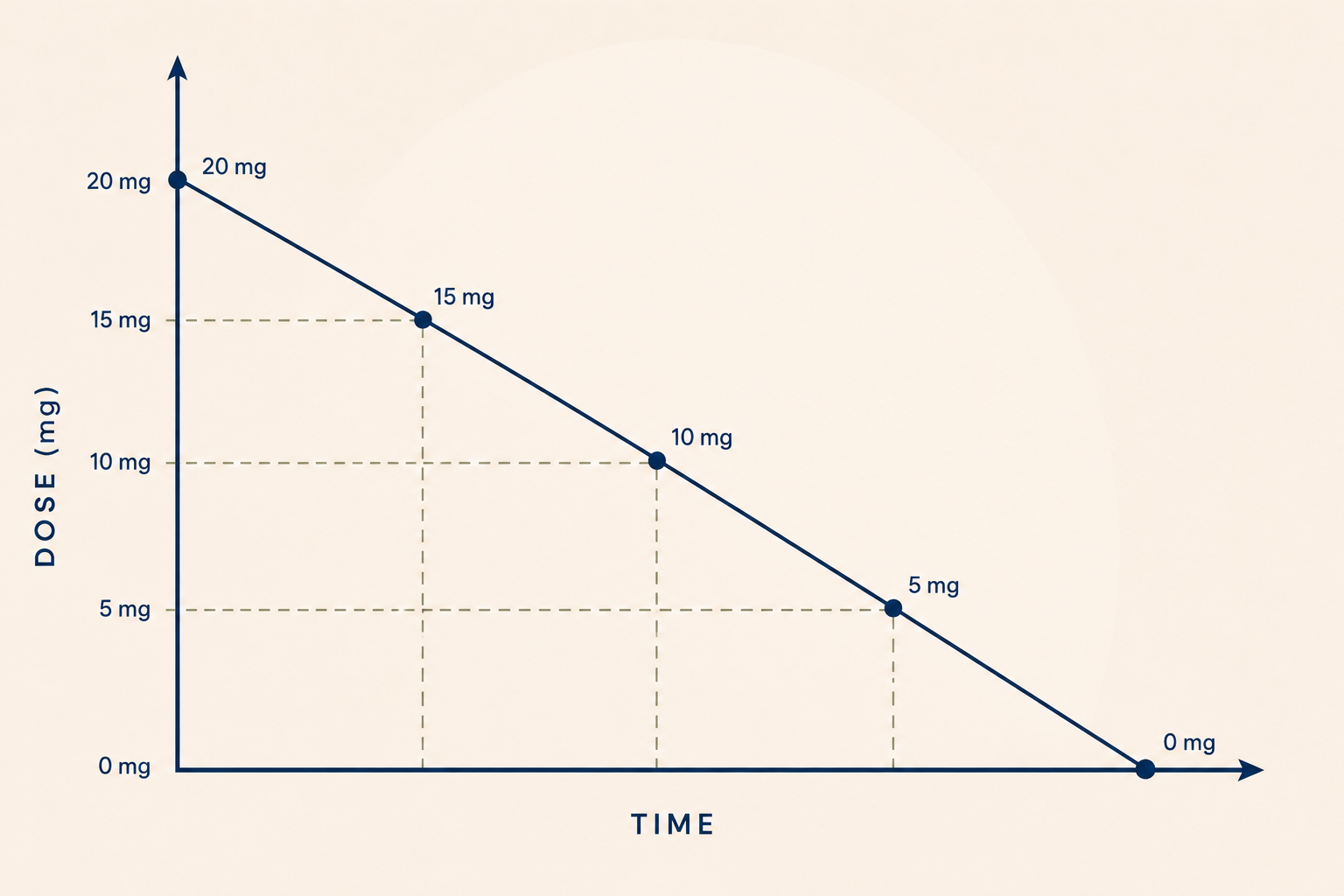
Linear Taper Approach
On paper, this seems reasonable. If you're removing 5 mg each time, you might expect each reduction to affect the brain by about the same amount.
But it doesn't necessarily work that way.[1]
Think of It Like Owning a Parking Lot
Imagine you own a parking lot with 100 spaces. To connect this to antidepressants, think of the parking spaces as receptors or targets in the brain, and the cars as medication interacting with those targets.
When your parking lot is mostly empty, each new car makes a noticeable difference. More spaces become occupied and your parking lot generates more revenue. But eventually, the lot becomes almost full. If 90 of your 100 spaces are already occupied, bringing in more cars doesn't increase your revenue nearly as much as it did in the beginning because there simply aren't many spaces left to fill. Your’re limited to 100 spaces. This is the idea of diminishing returns.

A similar relationship can occur between the dose of an antidepressant and its effect on certain targets in the brain. At lower doses, relatively small amounts of medication may already have an effect.
As the dose increases and more targets become occupied, each additional milligram may produce a smaller additional change.[1,2]
Now Think About the Parking Lot in Reverse
This is where the analogy becomes especially helpful for tapering. Imagine your parking lot is nearly full and five cars leave. You probably won't notice much difference. Most of your spaces are still occupied and most of your revenue is still coming in.
Now imagine there are only 10 cars left and five of them leave. You've just lost half of your remaining cars, and potentially a much larger portion of your remaining revenue.
The same five cars left in both situations, but the impact was very different.
Antidepressant tapering can work in a similar way. A reduction from 10 mg → 5 mg may have a different impact on your nervous system in comparasion to 20 mg → 15 mg, even though both are 5 mg reductions.
So, What Is Hyperbolic Tapering?
Hyperbolic tapering is an approach that takes this nonlinear relationship between dose and effect into account. Rather than reducing by the same number of milligrams at each step or routinely skipping days, the amount reduced becomes progressively smaller as the dose gets lower.
In other words, the taper follows the shape of the medication's dose-effect curve rather than simply moving down through evenly spaced doses. The aim is for each step to produce a more gradual change in the medication's effect on the brain, particularly at lower doses. Going back to our parking lot: as fewer cars remain, we become increasingly careful about how many we remove at once.
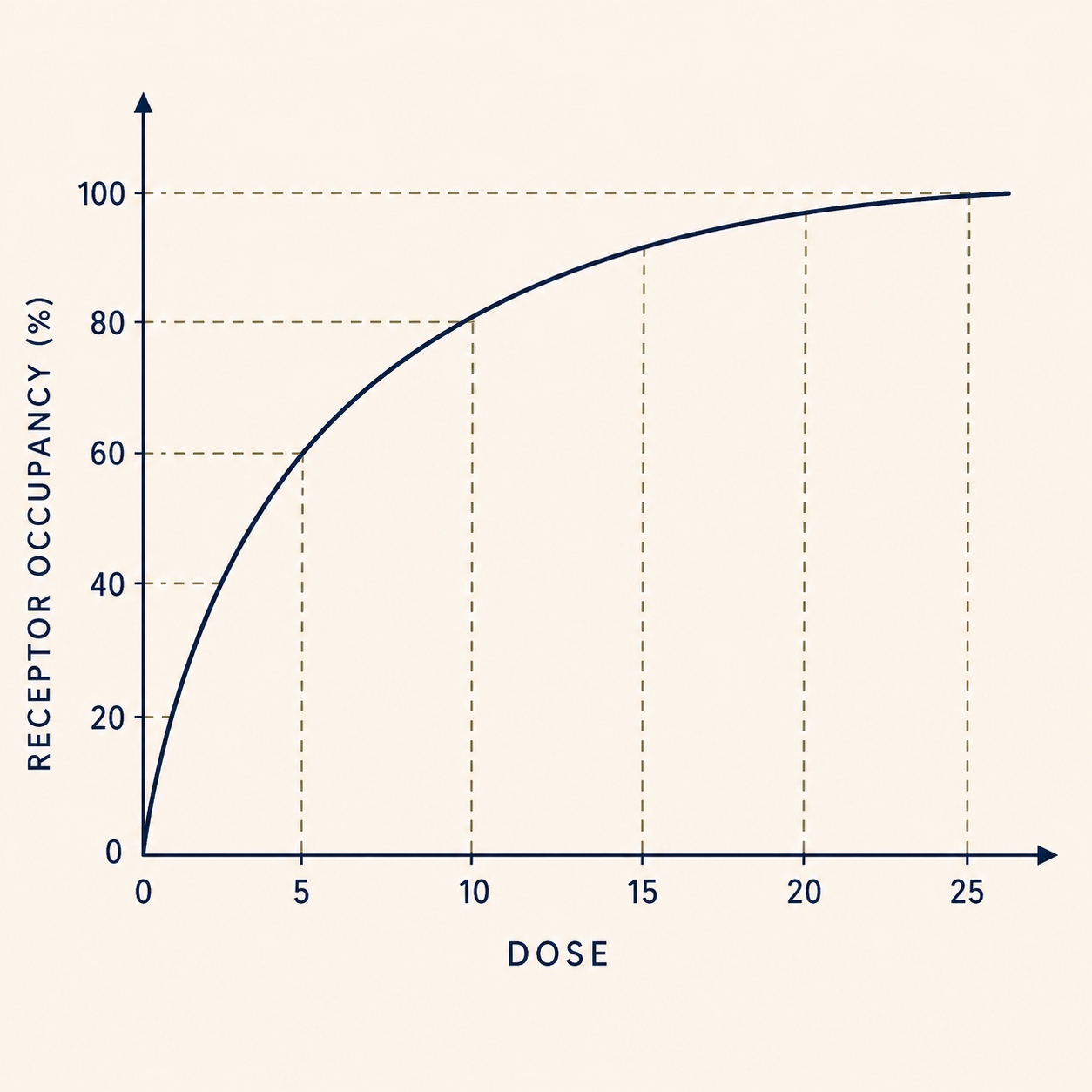
Hyperbolic Tapering
This chart uses sertraline (Zoloft) as an example to show how medication dose and receptor occupancy do not change in a straight line.
At higher doses, larger dose reductions may have a relatively small effect on occupancy. At lower doses, even smaller reductions can create proportionally larger changes, which is why tapering often becomes slower and more gradual as the dose gets lower.
Time between reductions also allows the nervous system and to adapt to each change.
One practical challenge is that medication manufacturers only make certain tablet and capsule strengths. For example, a medication may be commercially available as 20 mg, 10 mg, and 5 mg tablets. A hyperbolic taper may eventually call for smaller dose changes that don't line up neatly with those commercially available strengths. Depending on the medication, these smaller reductions may sometimes be achieved using liquid formulations, carefully measured doses, or compounded medications. The specific method depends on the medication and the individual taper.
There Is No One Hyperbolic Taper
Hyperbolic tapering is an approach, not a specific schedule. It does not mean everyone should reduce by the same percentage, wait the same number of weeks between reductions, or take the same amount of time to stop.
How someone responds can depend on many factors, including:
· Which antidepressant they take
· Their current dose
· How long they have taken the medication
· Previous experiences with withdrawal
· Sensitivity to medication changes
· How they respond to each reduction
Someone who has taken an antidepressant for several months may have a very different tapering experience from someone who has taken the same medication for many years. Previous difficulty with withdrawal may also influence how cautiously future reductions are approached.[1,2]
Guiding the Taper
A taper doesn't always need to be mapped out from the starting dose all the way to zero before it begins. Instead, the response to each reduction can provide useful information about what comes next.
Make a reduction → allow time to adjust → assess the response → decide on the next step.
If a reduction is well tolerated, the taper can continue. If significant withdrawal symptoms develop, the size or timing of future reductions may need to be reconsidered. This allows the taper to respond to the individual rather than requiring the individual to keep up with a predetermined schedule.[1,2]
Medication is only one part of the picture. Tapering can also be an opportunity to better understand your baseline: how you feel and function as the medication changes, and to recognize the difference between withdrawal, rebound symptoms, and the return of previous concerns. Along the way, building resilience and a supportive internal environment can be just as important as the taper itself. This may include developing greater self-awareness, working through underlying stressors or patterns, strengthening coping skills, supporting the nervous system, and tending to sleep, relationships, movement, nutrition, meaning, mindfulness, and other parts of wellbeing. The goal is not simply to reduce a medication, but to support the person throughout the process and beyond it.
Written by: Vivek Patel, MSN, FNP-C, PMHNP-BC
Medical Disclaimer: This article is for educational purposes only and is not a substitute for individualized medical advice. Do not stop or change a prescribed medication without discussing it with your healthcare provider.
References
1. Horowitz M, Wilcock M. Hyperbolic tapering of antidepressants: where are we now? Drug Ther Bull. 2026;64(1):3–7. doi:10.1136/dtb.2024.000065.
2. Lane C. How to Taper: An Interview With Mark A. Horowitz. Psychology Today. May 20, 2025.
